Helicon builds U.S. production for selected allied defense systems.
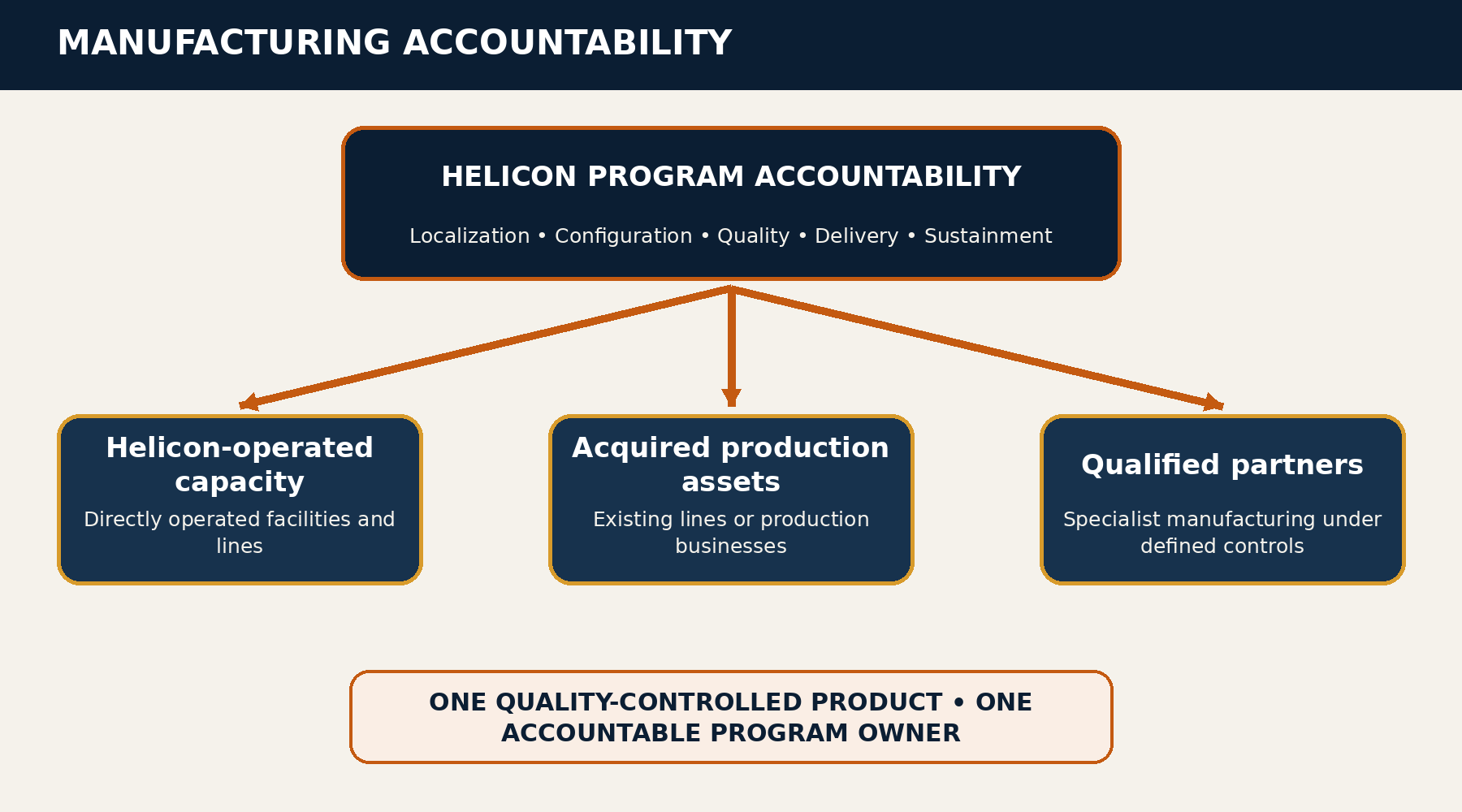
For each selected product, Helicon secures defined manufacturing rights, localizes the design and bill of materials, establishes quality-controlled production, and remains accountable for delivery and sustainment. Production may occur in Helicon-operated facilities, acquired production lines, or qualified partner facilities selected for the specific technology, scale, and customer requirement.
Current status
Current status
Helicon is building the production capacity, supplier network, quality discipline, and capital base required to manufacture selected technologies at U.S. and allied scale.
Helicon is actively qualifying technologies, negotiating commercialization pathways, building U.S. production capacity, and assembling the capital and operating infrastructure required to manufacture selected systems at scale. Product availability and customer programs remain subject to diligence, signed agreements, qualification, applicable law, and customer decisions.
Manufacturing accountability
What Helicon controls
- Product localization and configuration baseline
- Manufacturing and commercialization rights
- Trusted bill of materials and approved-source strategy
- Build-versus-buy and facility strategy
- Supplier and production-partner qualification
- Pilot and low-rate production planning
- Inspection, test, traceability, and quality requirements
- Cost, yield, throughput, and scale-up planning
- Customer configuration and delivery readiness
- Spares, repair, upgrades, and sustainment planning
Three production channels
Helicon-operated capacity
Production lines and facilities operated directly by Helicon for products where control, economics, security, quality, or scale justify direct operation.
Acquired assets or production businesses
Existing production capability acquired or integrated when buying rather than building creates the fastest credible path to capacity.
Qualified manufacturing partners
Specialist electronics, RF, mechanical, additive, composites, software, assembly, test, and sustainment partners used under defined quality, data, delivery, and accountability requirements.
Production workstream
This is the production workstream inside stages 04–07 of the canonical operating model — not a second stage model.
- Product and rights diligence
- Manufacturing-readiness assessment
- Product localization and configuration baseline
- Trusted bill of materials and supply-chain qualification
- Pilot build and test
- Quality-controlled low-rate production
- Scale-up, delivery, and sustainment
The canonical seven-stage model is the only stage model used sitewide.
Can your organization help Helicon build and sustain a qualified defense product?
Helicon is assembling a selective U.S. and allied production network. Prospective partners should begin with a non-confidential description of capabilities, certifications, capacity, location, ownership, security posture, and relevant defense experience.